
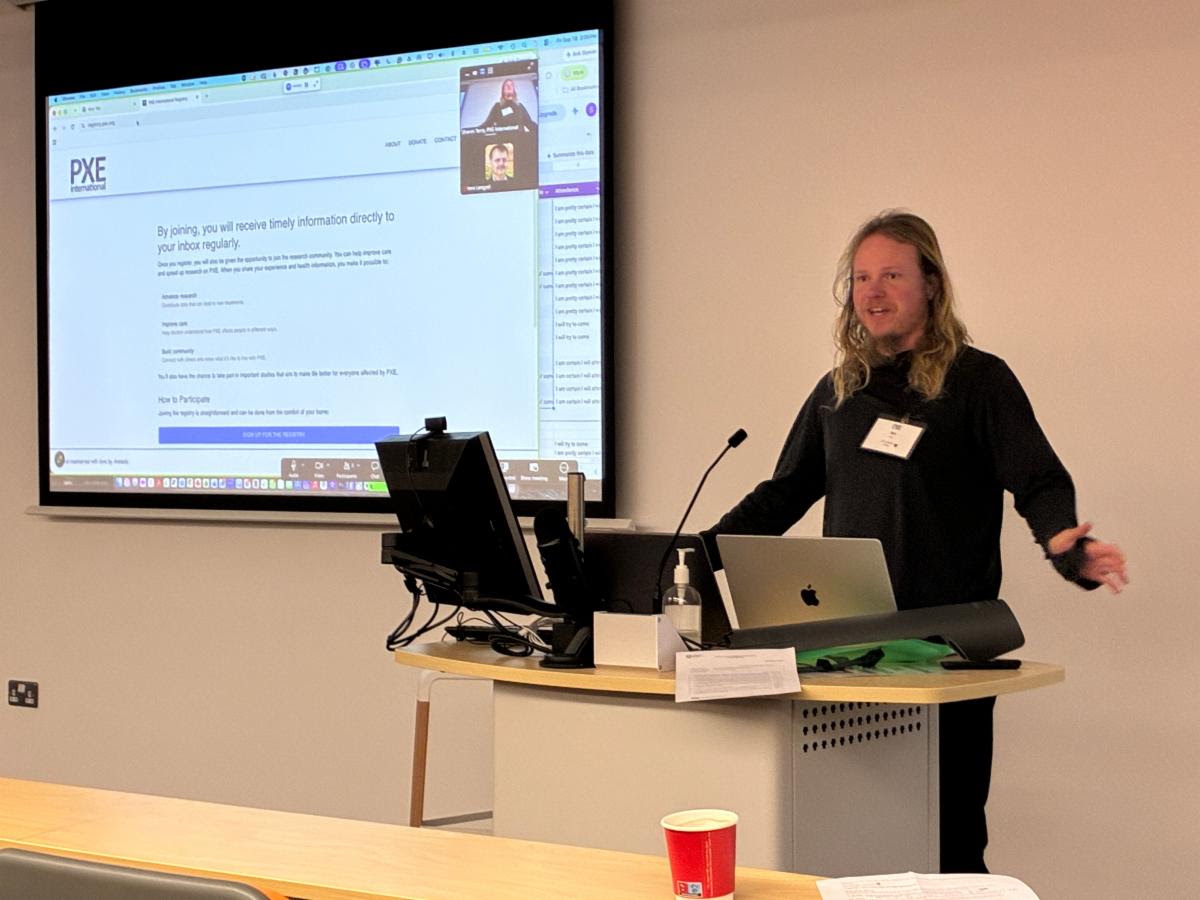
Ian terry at the PXE 2026 CONFERENCE
In September 2026, PXE International held a two-day community and research meeting at Queen's University Belfast. On the first day, patients, families, and researchers reviewed the science of pseudoxanthoma elasticum. On the second, attendees took part in an on-site research study.
PXE progresses slowly, often over decades. To get to clinical trials, researchers need longitudinal data showing how symptoms, biomarkers, imaging, and quality of life change within the same people over time. In most rare diseases, that information is scattered across hospitals, labs, past studies, and incompatible electronic health record systems. Every new study ends up reconstructing the community's history from scratch, and much of it is lost along the way.
Digital Cabinet reverses that model. Individuals gather their own health and research information in one place, including genetic test reports, imaging, clinical records, questionnaires, and research data. They decide how it's used and shared. The record belongs to the participant, not to any single study or institution, so it persists and grows across studies.
Ian Terry demonstrated the platform to attendees. Participants were encouraged to start completing their core PXE information, including diagnosis, disease severity, and baseline health data. This turned the meeting into an onboarding point for the community's long-term data effort. People who came to learn and to volunteer for the Belfast study left with a way to keep contributing afterward.
PXE International's broader strategy combines several efforts: the Belfast imaging and tear-sample feasibility study, dark adaptation research, pyrophosphate studies, and a natural history and biomarker program. Digital Cabinet is the layer that can hold all of this together for each person over time. It gives researchers a way to ask which measures change reliably, how much they vary within and between individuals, and which track meaningful disease progression. Those are the questions that determine whether future trials can effectively measure impact.
For an organization hoping to replicate this, the lesson is that events and individual studies are episodic, but the data infrastructure is what makes them cumulative. A participant-controlled platform lets a community own its research history and bring it to each new study, which strengthens its position as a partner rather than a data source. It also means an in-person event can do double duty: generating study data on site while enrolling people in a record that keeps building for years.
Learn more about Aretetic's registry platform at aretetic.com.
Back to All Posts